Meta's Muse and the Next Storefront
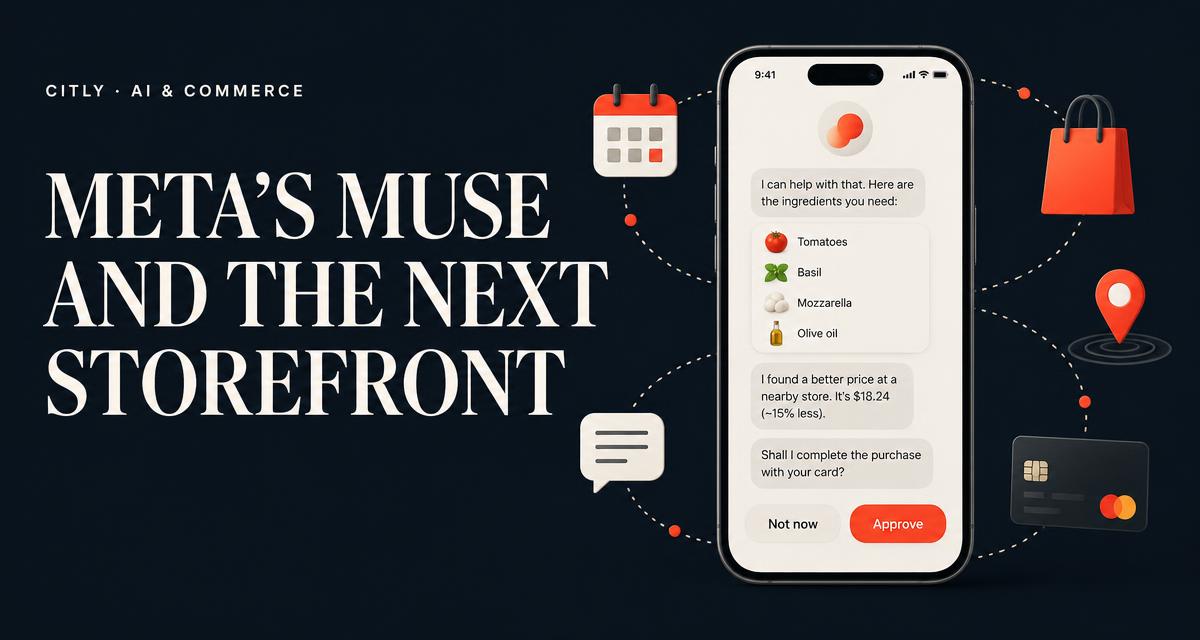
When I wrote about intent becoming the storefront, the clearest evidence came from AI assistants placing products inside answers. Meta's launch of Muse pushes that idea one step further. The assistant is no longer only helping someone decide. It is being designed to carry the decision through — browsing, comparing, filling forms and preparing a purchase for approval.
Mark Zuckerberg introduced Muse as a personal agent that understands a person's goals and works in the background to help achieve them. His examples were deliberately ordinary: organizing projects with his children, ordering ingredients, arranging permits, monitoring training and finding people he wanted to meet. That ordinariness is what caught my attention. Meta is not presenting an AI that waits for a perfect shopping prompt. It is presenting one that sits close to everyday life, where needs emerge before somebody thinks of visiting a store.
If an agent understands the goal, compares the options and prepares the payment, the storefront is no longer the beginning of the purchase. It may be the last system the agent touches.
What Meta actually launched
Muse launched in the United States on September 8, 2026 as a standalone app and an agent people can reach through WhatsApp. Meta says it can work across websites and apps, use its own browser, fill out forms, send emails and prepare payments. It can continue working while the app is closed, then return with progress or ask for a decision when it reaches a sensitive step.
The distinction matters. A chatbot produces language. An agent is expected to maintain context, make a plan, use tools and follow through. Muse is Meta's attempt to package that sequence for ordinary consumers rather than developers. The company is offering a large free allowance — announced as up to 100 million tokens a week — before paid plans for heavier use. Pricing and limits can change, but the intention is clear: Meta wants people to try delegation at consumer scale, not treat it as a specialist experiment.
Muse is a real Meta product. The secure virtual machine, background task work, credential store, approval before purchases or messages, and initial free usage allowance are all described by Meta or corroborated in launch reporting. Meta's stronger confidential-computing protection — designed so even Meta cannot access a person's agent data — is a future layer, not the standard already delivered to everyone.
Why this is an ecommerce story
Most ecommerce still assumes a person will travel through a funnel: notice something, search, compare, visit a store, add to cart and check out. Muse is built around a different unit of demand — the goal. A person says they want to cook with a child, train for a race, save money or organize a trip. Products and services appear as inputs to completing that goal.
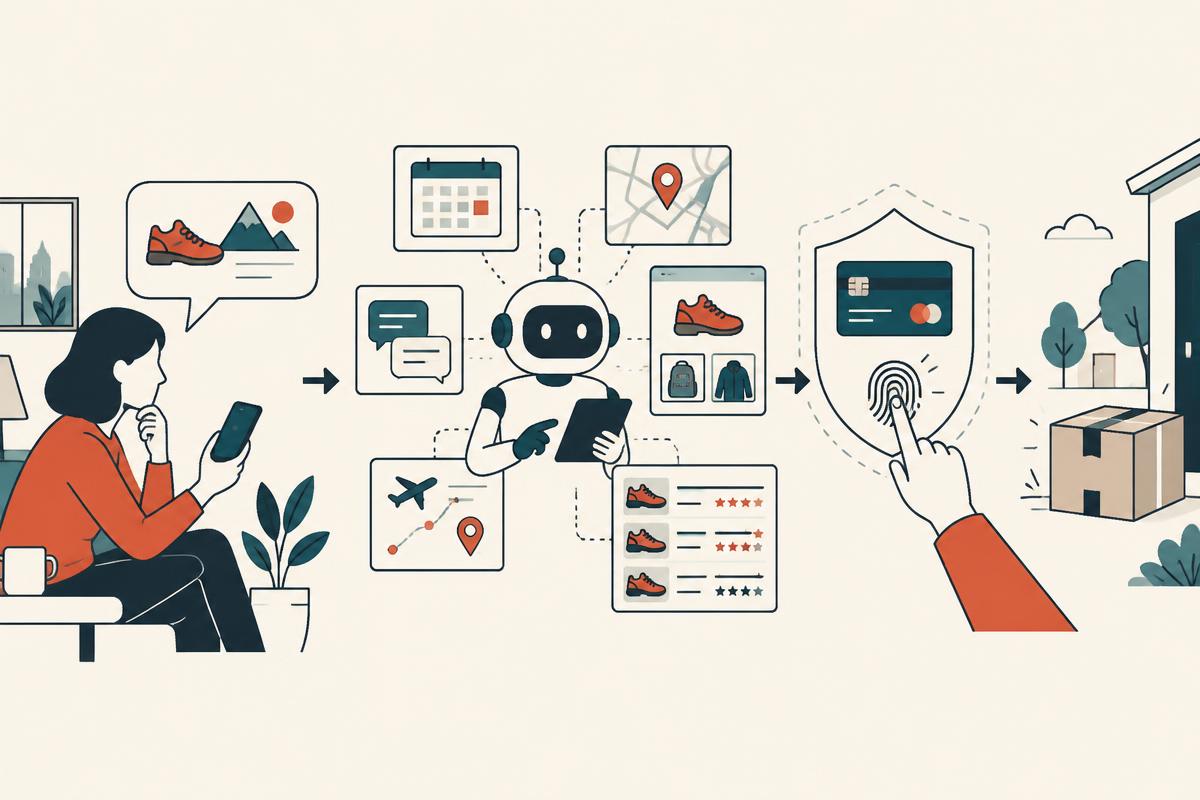
That changes when commerce begins. In the old model, buying intent is inferred from a search query or a product-page visit. In the agent model, the system may see the broader objective, the calendar, the location, the budget and the constraints. It can identify a purchase as one necessary step inside a larger plan.
Take Zuckerberg's baking example. The commercial opportunity does not begin when he searches for flour. It begins when he expresses the intention to bake with his daughter. An agent can turn that intention into a recipe, check what is missing, choose a shop, compare delivery windows and prepare the basket. The merchant may never receive the discovery visit that used to reveal where the sale came from.
Meta can see both sides of the transaction
Muse did not arrive on its own. In June, Meta introduced Business Agent for merchants across WhatsApp, Messenger and Instagram. Meta says those business agents can answer questions, recommend catalog products, book appointments, qualify leads and close sales. It also says more than one million businesses are already using the product, against more than one billion daily conversations between people and businesses across its apps. Those are Meta's reported figures rather than independently audited adoption numbers, but they show the scale of the distribution it is trying to activate.
Put the two launches beside each other and the shape becomes easier to see. On one side is a personal agent that understands the buyer's goal. On the other is a business agent that understands the seller's catalog, availability and rules. Between them sit Meta's messaging networks and a payment partner. That does not mean Meta has already created a universal agent marketplace. It does mean the company now has products aimed at both ends of an agent-assisted transaction.
The strategic advantage may not be that Meta built the smartest shopping model. It may be that the buyer, the seller and the conversation are already inside its network.
The approval screen is the new checkout
Meta says Muse asks before it takes sensitive actions such as sending a message or making a payment. For purchases, launch reporting describes an integration with Stripe Link using one-time card details. That small approval moment may become one of the most valuable pieces of interface in commerce.
A conventional checkout asks the buyer to confirm a basket they assembled themselves. An agent approval screen asks them to confirm a basket assembled on their behalf. Trust therefore has to cover more than payment security. The buyer also needs confidence that the agent interpreted the goal correctly, compared suitable options, disclosed any commercial influence and stayed inside the budget.
That creates a new competition around the recommendation before the approval. Merchants will want to know why one product was selected, what information the agent used, whether stock and delivery promises were current, and how a return or substitution is handled. Payment networks are already developing ways for merchants to recognize legitimate shopping agents and verify that a consumer authorized them. The plumbing is being designed while the behavior is still new.
Privacy is not a side issue
The more useful a personal agent becomes, the more context it needs. A system planning a trip may need dates, messages, preferences, location and payment access. One managing health goals may see information that is much more sensitive. Meta appears to understand that adoption depends on whether people believe this context is contained.
Muse therefore runs inside what Meta calls a Secure VM: a dedicated virtual computer with a browser and an isolated credential store. Meta says the agent cannot read the raw passwords or card details held there. It also uses a separate control layer to check proposed actions, with the person kept in the loop for payments and communications.
I would still separate architecture from trust. The launch design creates boundaries around the agent, but Meta's planned higher-security version — where cryptographic controls are intended to prevent even Meta from accessing the information — is still to come. Accessing Muse through WhatsApp also should not be confused with proof that every part of the agent currently has WhatsApp's end-to-end encryption model. The direction is meaningful; the stronger guarantee is not yet the default product.
What this says about the industry
Meta is not alone. ChatGPT introduced Instant Checkout with Stripe's Agentic Commerce Protocol. Perplexity added buying flows. Google introduced the Universal Commerce Protocol with retailers and payment companies. Amazon has continued moving its shopping assistant toward monitoring and action. The implementations keep changing — and some early checkout approaches have already been adjusted — but the direction across the industry is remarkably consistent.
The competition is moving from who can answer a product question to who can complete the surrounding job. Search companies bring queries and product indexes. Marketplaces bring inventory, fulfillment and purchase history. Payment companies bring identity and authorization. Meta brings messaging, social context, merchants and daily conversation. Each is approaching the same opportunity from the asset it already controls.
What remains unproven is scale. A launch video can show a smooth task; it cannot show how often people will delegate real purchases, how frequently agents will make the right choice, or whether consumers will trust a platform with enough context to make the service useful. It is also too early to call agent-driven transactions a meaningful revenue stream for the major platforms. The infrastructure is real. Mainstream behavior is still being tested.
What businesses should take from it
I would not respond by trying to build a Muse strategy around a product that is two weeks old. I would respond by making the business easier for any legitimate agent to understand and transact with. The practical work is less dramatic than the launch video:
- 1
Describe the outcome, not only the product. Agents start with goals. Explain which situation a product solves, who it suits, what it does not suit and the constraints that affect the choice.
- 2
Keep price, stock and delivery information dependable. An agent acting on stale availability or an incomplete fee is not creating convenience. It is creating a failed promise on the merchant's behalf.
- 3
Make policies machine-readable and human-clear. Returns, substitutions, warranties, cancellations and booking rules become part of the agent's decision, not fine print discovered after checkout.
- 4
Prepare for fewer discovery visits. If the agent compares options before reaching the site, analytics based only on page sessions will miss more of the decision. Track referrals, citations and agent-originated transactions where platforms expose them.
- 5
Protect the moment of consent. The final approval must show what will happen, what it costs, who is providing it and what the buyer can change. Trust will be won or lost in that handoff.
The bigger signal
The headline is that Meta launched an AI agent. The more important signal is where it placed that agent: between a person's ongoing goals and the services needed to complete them. That is much closer to commerce than a chatbot sitting beside a search box.
My earlier argument was that intent could become the storefront. Muse makes the proposed storefront easier to picture. It is a conversation that remembers the objective, a worker that handles the steps, and an approval screen at the point where judgment becomes a transaction.
It may take longer than the launch suggests. People may delegate planning but stop short of payment. Privacy concerns may limit how much context they share. Merchants and regulators may demand clearer rules around ranking, disclosure and liability. None of that makes the launch unimportant. It shows that one of the world's largest consumer platforms now sees the same destination clearly enough to build toward it.
Commerce has always followed human intent. Muse is evidence that the industry now wants an agent to meet that intent before a store ever does.
Sources and further reading
- Meta — Introducing Muse: The World's First Personal AI Agent Built for Everyone
- Meta AI Research — Security and Safety for AI Agents: Our Approach With Muse
- Meta — Be There for Every Customer With Meta Business Agent
- Meta — Personal Superintelligence for Everyone
- OpenAI — Buy It in ChatGPT: Instant Checkout and the Agentic Commerce Protocol
- Stripe — Stripe and OpenAI Introduce Instant Checkout in ChatGPT
- Amazon — Introducing Alexa for Shopping
- Mastercard — Agent Pay Acceptance Framework
- Visa — Trusted Agent Protocol specifications
Get new articles by email
One email per published article. Nothing else.