Is Intent the Future of Commerce?
I evaluate AI claims for a living — it’s literally part of my day job — so I’ve trained myself to notice when something stops being a press release and starts being real. Over the past year, I kept noticing this: ask an AI assistant about almost anything — ChatGPT, for instance — and along with the answer, you’ll often get a specific product to buy, complete with a price and a link.
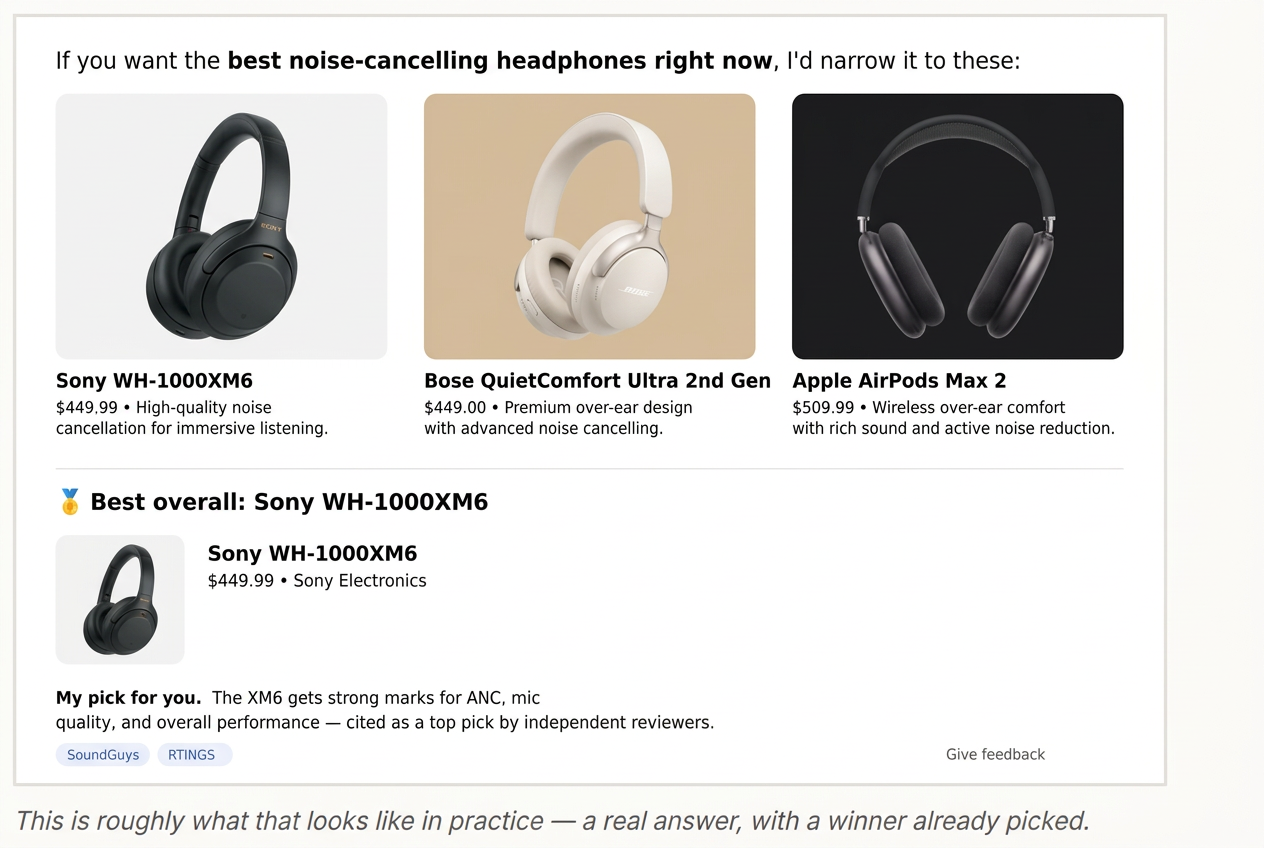
I tested it myself, over and over. Knee pain. The best noise-cancelling headphones. Which laptop is good for video editing. Best study packs for my kids. Where my next vacation should be. The pattern held across every assistant I tried — no links to weigh, no tabs to open. A product name, a price, a link — and nobody asked to buy anything. The first time it happened, I sat back and thought: whoever that answer belongs to just made a sale without a store, without an ad, and without being asked.
What’s actually different here
My first instinct — the instinct my day job has drilled into me — was to call this a repackaged recommendation engine and move on. Amazon has been doing that for twenty years. But the more I dug in, the clearer it got that this is something else: none of the usual steps happen anymore — no searching, no comparing, no clicking through anything to get there. The assistant just decides, mid-conversation, and hands over the checkout.
Ads interrupt what you’re doing. This just… replaces it.
ChatGPT launched Instant Checkout in September 2025, starting with Etsy and Shopify merchants and built with Stripe on the open Agentic Commerce Protocol. Perplexity has its own “buy” flow. Google surfaces products directly inside AI Mode and has announced its own Universal Commerce Protocol. Three companies, same behavior, same window of time — shipped product, not a roadmap slide.
Where discovery happens now
Here’s the part I can’t stop thinking about. Language models don’t hand out ten links anymore — they synthesize one answer, and whoever gets cited inside it basically wins the interaction. A question like “which running shoes are good for flat feet” used to be three steps: research, compare, buy. Now it’s one. Most businesses I talk to still haven’t clocked what that means — and I get why, because I almost missed it myself.
And I don’t say that lightly, because I’ve been burned before by announcements that evaporated. I went and checked. Instant Checkout inside ChatGPT, Perplexity’s “buy” flow, and Google surfacing product results directly inside AI Mode — the same “AI Mode” in the diagram above — are all live today. I’ve run the same buying questions through all three. These aren’t experiments buried in a labs page. They’re shipped product, from three separate companies, all converging on the same behavior at the same time.
The part that changes the funnel
When I explain this to people, they almost always assume it only affects shoppers — people already in buying mode. That assumption may be incomplete, and I think that distinction is important. The AI is monetizing curiosity, not purchase intent. Someone researching magnesium for better sleep wasn’t shopping for anything — they leave the conversation with a product recommendation regardless.
Which means the funnel has effectively flipped — and having spent years on the buyer’s side of that funnel, I can tell you this is the part that should make people sit up. An educational question in a business’s category is now a sales opportunity nobody had to bid for. Old SEO chased keywords. This cares whether the model already knows who a business is and trusts what it knows — which, mechanically, mostly comes down to whether independent sources back up the claims being made.
So what does a business actually do about it
This is the list I’d hand to a friend building something right now — roughly in order of how much each thing matters:
- 1
Be one consistent thing everywhere. Same name, same facts, same description, on the website, in directories, in reviews. My view is that consistency matters more than cleverness here — contradictory information can make it harder for models to confidently identify and describe a business.
- 2
Make the data boring and machine-readable. Product schema, pricing, FAQs. Not exciting work. Necessary work — an AI can’t recommend what it can’t parse.
- 3
Get other people to vouch for the brand. Reviews, comparisons, someone else’s post mentioning it by name. In my experience, independent corroboration is likely to matter more than self-description alone.
- 4
Get the commerce plumbing ready for an agent, not a person. Clean APIs, real-time stock, payment integration a bot can actually use. The plumbing now has names: the Agentic Commerce Protocol (ChatGPT and Stripe) and Google’s Universal Commerce Protocol are the two competing standards for agent transactions. If an assistant can’t transact with a business directly, it’ll transact with whoever it can.
- 5
Start tracking citations, because rankings won’t show this. The question isn’t where a business sits on a results page. It’s whether it shows up at all when someone asks the AI the buying question in its category.
This is the part that’s personal for me. I’ve spent my career watching what happens to businesses that wait. Commerce has always followed wherever people actually ask their questions — storefronts, then catalogs, then search, then social. Every time, the ones who moved early built for the new surface while everyone else kept polishing the old one. I know how that movie ends for the late movers, and I’d rather not watch it play out again from the sidelines.
Where this still needs watching
I’m not writing this as a cheerleader. Consumers may push back hard on getting sold something when they asked a health question, and honestly, part of me thinks they’d be right to. Regulatory scrutiny is already building. At some point these platforms will want their cut, the same way every distribution layer eventually does. And there’s a harder question underneath all of it that I keep coming back to: when the AI recommends something, is it because that’s genuinely the best option, or because there’s a commercial relationship involved that isn’t visible from the outside? Right now, there’s no reliable way to tell the difference — and that bothers me more than any of the rest of it.
Even so, I’d rather be early and wrong than late and certain. Google turned “ads next to an answer” into one of the biggest businesses that has ever existed. This is ads inside the answer. That’s a hard case to make smaller, not larger.
Intent is becoming the storefront. The real question is who takes it seriously in time.
This is the shift I’d put my money on. But being early isn’t the same as being right, and I’d genuinely like to be proven wrong if I am. If you’re seeing the same pattern — or you think this is still early enough to dismiss as a blip — I’d like to hear it.
Get new articles by email
One email per published article. Nothing else.