AI Hype and the Rest of Us
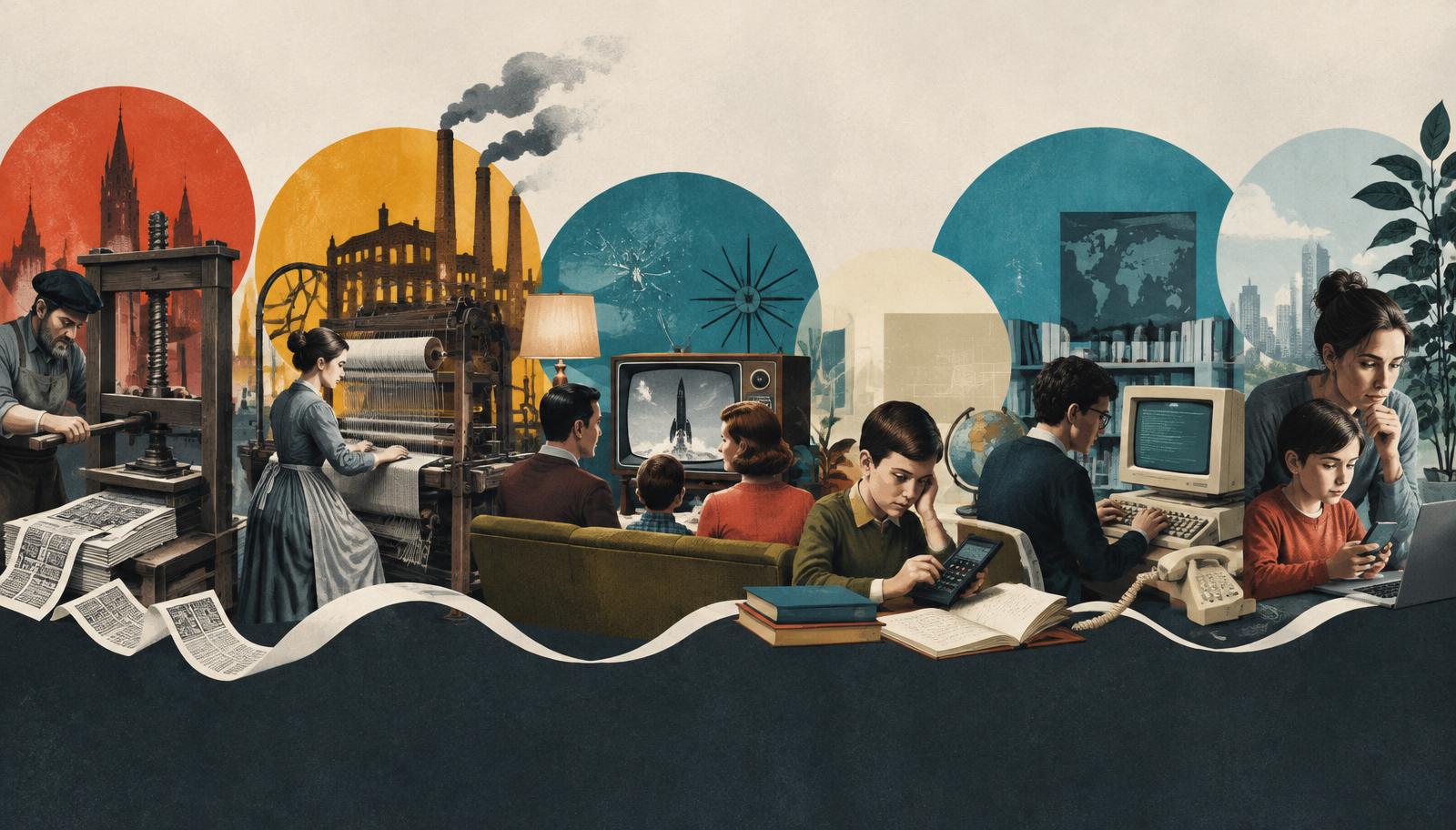
There is something unusual about the way we are talking about artificial intelligence. Every few months, the conversation seems to move forward another step. First, AI was something that could answer questions. Then it could write, summarize, translate and create images. Then it could code. Now we are talking about agents that can perform tasks, systems that may reason across problems, artificial general intelligence and, eventually, superintelligence.
For those building these systems, this may feel like a race toward the next frontier of human capability. For the rest of us, the questions are much more ordinary.
What happens to my work? Will the skills I spent years developing still have value? What should I teach my children when the machines can already do much of what we are asking them to learn? Should schools restrict AI — or are they preparing children for a world that has already changed? How much of our lives, conversations, decisions and personal information are we willing to place inside systems we do not control?
And perhaps the most uncomfortable question: if AI makes one person capable of doing the work of three, what happens to the other two?
These questions are not signs that we are afraid of progress. They are the natural questions people ask when the economic and social rules around them appear to be changing faster than they can understand them.
That feeling is not new. Our grandparents experienced it when machines entered factories. Their parents experienced it when railways and telegraphs compressed distance. Earlier generations watched the telephone, radio, television, calculators, computers and eventually the internet enter places that had previously belonged almost entirely to human beings. Each generation wondered, in its own way, whether something important was being lost.
Sometimes the fears were exaggerated. Sometimes they were remarkably prescient. And sometimes the technology really did take someone's livelihood, change an industry or alter the relationship between ordinary people and the institutions that held power. That distinction matters, because history should not be used to tell us, “Don't worry. People have worried about technology before.”
Technological change can be both enormously beneficial and deeply disruptive at the same time.
The question is not whether AI is good or bad. The question is what happens to ordinary people when a technology capable of performing increasingly sophisticated human tasks becomes cheap, scalable and available almost everywhere. That is the conversation I want to have here — not about whether AI will save humanity, not about whether it will destroy humanity, and not about which prediction about superintelligence will eventually prove correct, but about something much closer to home: what does this technological revolution actually mean for the rest of us?
We have heard versions of this before
- 1
The printing press changed who could control knowledge. In fifteenth-century Europe, it threatened scribes' livelihoods and weakened the gatekeeping power of religious and political authorities. The response was not only celebration. Licensing, censorship and new ideas about authorship followed. Society did not simply accept print; it built rules around the power print redistributed.
- 2
Industrial machinery changed the value of skilled work. The Luddites of 1811–1816 were not people frightened by every machine. They were skilled workers resisting uses of machinery that cut wages, weakened standards and transferred power to factory owners. Mechanisation later created wealth and new occupations, but that long-term result did not erase the immediate losses borne by particular families and towns.
- 3
Railways and the telegraph compressed distance. Nineteenth-century observers worried about speed, physical safety, surveillance and the loss of privacy in transmitted messages. Some medical claims about rail travel were fanciful. The accidents, communications privacy problems and power of networks were not. Safety standards, compensation systems and legal protections had to catch up.
- 4
Radio and television entered the family home. Adults worried about propaganda, violence, attention and children's development. Not every claim survived evidence, but the concern produced research, broadcasting standards, age guidance and family routines. The useful answer was neither an outright ban nor an open door.
- 5
Calculators and computers entered classrooms and offices. Teachers feared the loss of arithmetic and employers heard predictions of mass technological unemployment. Schools eventually learned to preserve foundational skills while teaching the new tools. Computers did remove and reshape many tasks, but work changed more often than it vanished altogether.
- 6
The internet made access almost unlimited. It expanded knowledge, business and connection while also creating fraud, surveillance, addictive design and misinformation at enormous scale. The dot-com boom also showed how a technology can be genuinely transformative while investors and companies exaggerate how quickly its value will arrive. The Nasdaq Composite rose roughly 400 percent from 1995 to its March 2000 peak, then fell almost 78 percent by October 2002. The hype broke; the internet did not. Password habits, parental controls, privacy laws and media literacy arrived after exposure, not before it. We are still correcting that delay.
There is a pattern here, but not the comforting one that says earlier worriers were always wrong. They were often wrong about the exact mechanism and right about the direction: power was moving, some work was losing value, private life was becoming more exposed, and children were meeting a medium adults did not yet understand.
What is different about AI
AI combines several earlier changes at once. It is a medium, a workplace tool, a tutor, a creative machine and, increasingly, an agent that can take actions. It can reach millions of people before schools, laws or families have agreed on basic boundaries. And unlike a calculator, it can produce a fluent wrong answer that feels like judgment.
That makes today's practical risks more important than arguments about a hypothetical superintelligence. A 2025 study by the International Labour Organization and NASK estimates that one in four workers worldwide is in an occupation with some exposure to generative AI, while concluding that transformation is more likely than full replacement for most jobs. Exposure is not the same as job loss. But a job does not have to disappear for a worker to feel the change: a team that once needed ten people may need six, or stop opening the junior roles through which people learned the work.
The disruption is no longer only a forecast
The careful claim is not that AI will eliminate work. It is that AI may reduce the amount of human labor needed for particular kinds of work. That distinction is where the disruption begins. It can appear as fewer contractors, slower hiring or a smaller team rather than a headline announcing that an occupation has vanished.
Companies are now saying so openly. Challenger, Gray & Christmas, which tracks announced U.S. layoffs, reported that AI was the leading reason employers gave for job cuts for five consecutive months through July 2026, with technology firms accounting for almost a third of all cuts. Two cautions belong next to that number. A company citing AI is not proof that AI alone removed each job, and the same report found overall layoffs down and hiring plans up. In the firm's own words, AI is shifting the labor market, not dismantling it. Still, employers are now openly linking workforce decisions to AI. That is no longer a forecast.
Layoffs also undercount the change. A layoff is visible. A role that is never posted is not. A company can say it is not cutting anyone while quietly hiring 500 fewer people than planned, or report that staff are 40 percent more productive with AI. If revenue stays flat, that productivity eventually means fewer people needed for the same work. AI does not have to eliminate an occupation to eliminate jobs. It only has to reduce how many people the work requires.
Klarna offers a useful warning against simple conclusions. In February 2024, the company said its AI customer-service assistant was handling two-thirds of its chats and doing the equivalent work of 700 full-time agents. Those agents were supplied through outsourcing partners, not laid-off Klarna employees. By May 2025, chief executive Sebastian Siemiatkowski said the cost-focused approach had gone too far and that Klarna was bringing more human service back because quality still mattered. AI reduced the labor requirement, but the result also exposed what the software could not replace well.
Duolingo shows the pressure from another angle. The company confirmed that it cut about 10 percent of its contractors at the end of 2023, including people working on translation and lesson content, while increasing its use of generative AI. No full-time employees were included in that reduction, and the company disputed describing every cut as a direct replacement. The distinction matters, but so does the outcome: the amount of paid human work required to produce a unit of content had changed.
The deeper concern may be the first rung of the career ladder. A 2026 World Economic Forum and PwC report found that more than one in three young workers globally were employed in occupations with medium-to-high exposure to AI-driven task change. Junior analysts, writers, programmers and designers traditionally gained judgment by doing simpler work first. If that work is automated, companies will have to create new ways for inexperienced people to become experienced.
The honest position is neither ‘AI is taking every job’ nor ‘AI only changes tasks.’ It is that task automation can still reduce hiring, bargaining power and the number of people a company needs.
For children, the immediate question is not whether AI becomes conscious. It is whether a child learns to think before asking a system to think for them, whether a chatbot is mistaken for a friend or authority, and whether private information becomes training material. UNESCO's guidance calls for a human-centred, age-appropriate approach and stronger protection of personal data. A school ban can buy time, but a ban by itself does not teach judgment. Unrestricted use does not teach it either.
The same discipline applies to privacy and truth. The U.S. Federal Trade Commission has warned AI companies that promises about confidentiality and data use must be honored. Yet the safest household rule is simpler: do not give a chatbot information you would not hand to an unknown company employee. And when an answer matters — health, money, school, law or reputation — fluency is not verification.
It is a forecast, not a present consumer product. Serious researchers disagree about whether it will exist, when it could arrive and how dangerous it might be. We should expect companies and governments to prepare for high-impact possibilities, but families should not let a disputed future distract them from today's choices about data, learning, spending and trust.
Most of us will be users — that still gives us power
Most people will not build foundation models. We will use AI inside search, phones, schools, offices, banks and shops. That can make us customers, sources of data and cost centres on a company's balance sheet. It does not make us passive. Adoption is a decision made repeatedly: which tool, for which task, with what information, at what price and under whose judgment.
The companies benefit when AI feels inevitable and urgent. Consumers benefit when it is useful, contestable and easy to leave. The difference matters. A tool should earn a place in family life or work by saving time, improving access or extending capability — not because the loudest forecast says everyone else is racing ahead.
A calm way to deal with the hype
- 1
Separate the tool from the prediction. Ask what the product can reliably do today. Treat claims about AGI, superintelligence and the end of work as forecasts, not features.
- 2
Preserve the skill before adding the shortcut. Children should learn to write, calculate, research and reason before routinely outsourcing those steps. AI can then extend a foundation rather than replace one.
- 3
Keep sensitive life out of the prompt box. Avoid names, school details, medical records, account information, confidential work and identifiable family problems unless the service and the need clearly justify it.
- 4
Verify in proportion to the consequence. A dinner idea needs little checking. Medical, financial, legal and educational claims need an original source or a qualified human. Never mistake a confident tone for evidence.
- 5
Make family rules specific. Decide which tools are allowed, when an adult should be present, what information is off-limits and when AI use must be disclosed. Clear boundaries work better than vague fear.
- 6
Audit the cost and the dependence. Review AI subscriptions like streaming services. Keep copies of important work in portable formats, and ask whether you could still complete the essential task if one service disappeared or raised its price.
Our turn to set the terms
Earlier generations did not manage social change by predicting it perfectly. They argued, experimented, organized, researched harms, wrote laws and developed new habits. Progress was uneven, and the people who absorbed the first losses were not always the people who enjoyed the later gains. That is precisely why history should make us attentive rather than relaxed.
The honest historical argument is not that fear was foolish because everything worked out. Workers lost wages, privacy was weakened and children encountered harms before protections caught up. In several transitions, public concern helped create the pressure for safety standards, labor protections, privacy rules and new teaching practices. Anxiety is most useful when it becomes evidence, institutions and habits rather than helplessness.
We do not have to choose between being excited by AI and being careful with it. We can use it without surrendering judgment, teach it without abandoning foundations, and demand safeguards without pretending the technology can be uninvented. This generation is not the first to feel that the ground is moving. Our responsibility is the same one earlier generations eventually accepted: decide what the new tool is for before the people selling it decide for us.
The answer to AI hype is not panic or obedience. It is informed use, clear boundaries and the confidence to keep human judgment in charge.
Sources and further reading
- The National Archives — Why did the Luddites protest?
- Library of Congress — Communication Technology: The New Media in Society
- Federal Reserve History — The Dot-Com Bubble
- UNESCO — Guidance for generative AI in education and research
- International Labour Organization — Generative AI and Jobs: A 2025 Update
- Klarna — AI assistant handles two-thirds of customer service chats
- Bloomberg — Klarna turns from AI to human customer service
- TechCrunch — Duolingo cut 10% of its contractor workforce
- World Economic Forum — AI and the Future of Entry-Level Work
- U.S. Federal Trade Commission — AI companies: Uphold your privacy and confidentiality commitments
- OECD — Children and Young People's Mental Health in the Digital Age
Get new articles by email
One email per published article. Nothing else.